November 12, 2026 · Twitter Ban Service · 12 min read
Takedown service: what it routes, monitors and declines on four platforms
A takedown service matches each fake account, stolen post or abusive video to the platform rule it breaks, then files that case through the platform's own form. It cannot delete anything itself. Instagram, for example, says it only responds to impersonation reports from the person impersonated or their representative, so authorization comes before filing.
What does a takedown service actually do?
A takedown service identifies the rule a piece of content breaks, assembles proof, and submits the case through the platform's official reporting channel.
The work is clerical and evidentiary, not technical. Nobody outside X, Meta, YouTube or TikTok holds a delete button, so a content takedown service is paid for three things: knowing which policy applies, knowing which form accepts that policy, and presenting evidence a reviewer can check in a minute. Impersonation goes to an identity form. A copied video goes to a copyright notice. A threat goes to the abuse report, and a false statement of fact may need a court before any platform will act. Mixing those routes up is a common reason a valid complaint gets closed without action. Twitter Ban Service is a reporting service built around X accounts that break the X Rules, and the same routing logic carries to the other three platforms when one bad actor runs profiles on several of them. A filing can be precise, complete and still refused.
That refusal is the platform's call.
Which violation goes to which platform route?
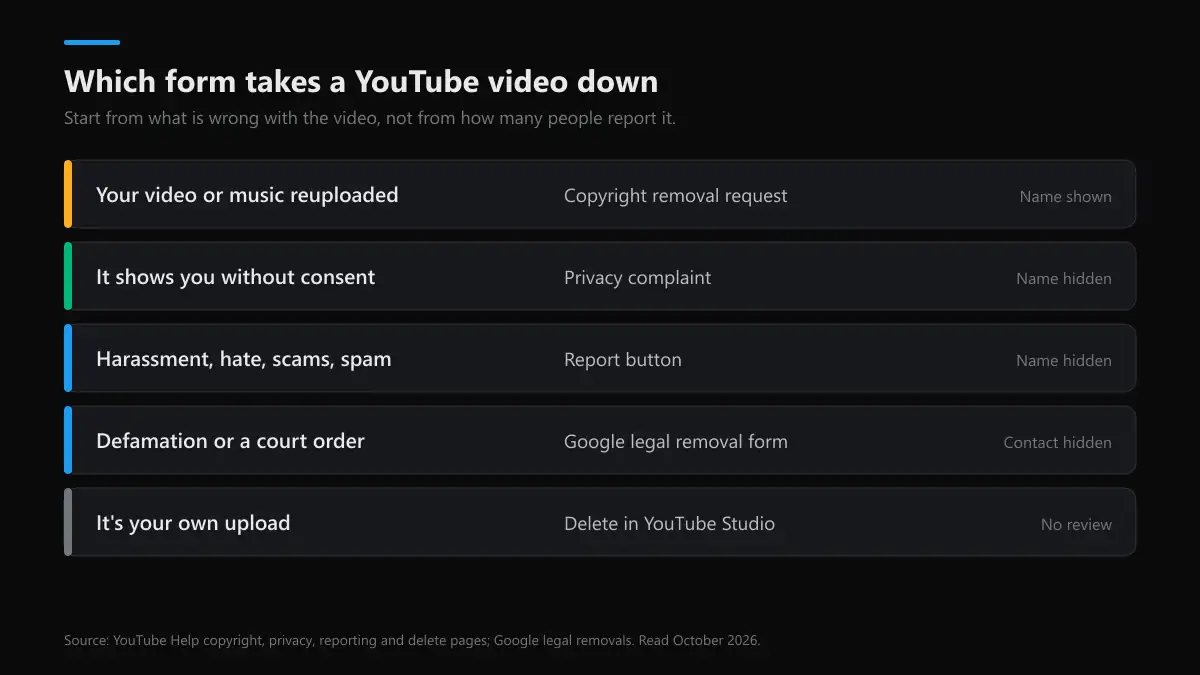
Route by violation first and platform second, because every platform sorts incoming reports by rule type before anything else.
| Violation | X | Facebook and Instagram | YouTube | TikTok |
|---|---|---|---|---|
| Impersonation | Impersonation form, filed by the person copied or an authorized representative | Profile report, or the identity form for the person copied | Channel report under the impersonation policy | Reporting a fake TikTok account |
| Scam or fraud | In-app report on the post or profile | Facebook scammer reports, scam ad routes on Facebook and Marketplace seller reports | Reporting a YouTube ad | TikTok scammer reporting and TikTok Shop seller complaints |
| Harassment | Abuse report on the post | Facebook harassment reports | YouTube's harassment policy | Reporting a TikTok LIVE when the abuse is broadcast |
| Copied work | Copyright (DMCA) form | Meta copyright report form | Copyright removal request | TikTok copyright infringement report |
| False statements of fact | Legal request, usually with a court order | See libel on Facebook | Google legal removal form | Legal request, usually with a court order |
The second sorting question is scale: one post, or the whole account? Platforms judge them separately. A single rule-breaking post rarely removes a profile, which is why post-level versus Page-level reports on Facebook lead to different reviews, and why reporting a whole YouTube channel asks for a pattern across uploads. The same split decides a channel or video takedown on YouTube and shapes what a TikTok account ban request can rest on. On Meta, the menu wording changes by surface, so it helps to read the Facebook abuse reporting categories and the Facebook post removal routes by case before choosing. X differs again; this comparison of how TikTok and X reporting differ shows where the menus part ways.
Meta impersonation report: who can file, and with what?
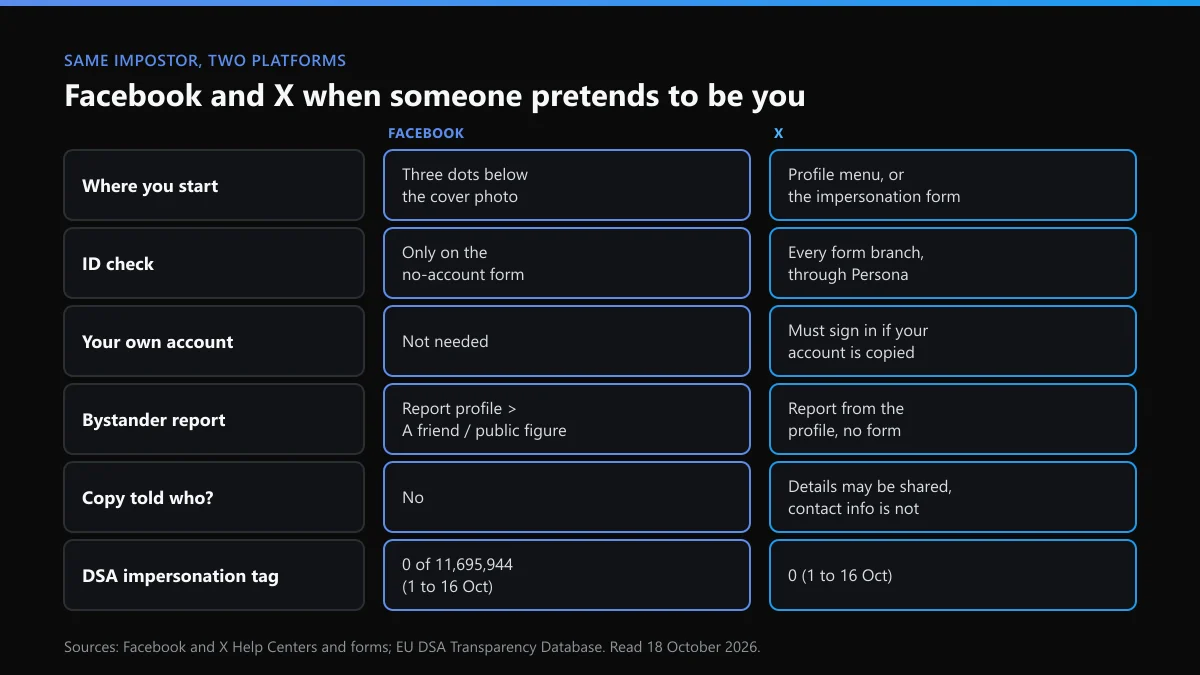
Only the impersonated person or their representative can complete the identity form, according to Instagram's Help Center.
The article What can I do if someone is impersonating me on Instagram? says Instagram only responds to reports from the person being impersonated or a representative of that person, such as a parent. It asks for a photo of a government-issued ID, and the form is open to people with no Instagram account. Bystanders can still flag the fake from its profile menu. People who search report impersonation meta often expect a single door; there are two, and the identity door needs the victim's own documents. For a service, that rule sets the method. Twitter Ban Service prepares the evidence pack and either files as an authorized representative or hands the client a ready-to-submit file, and never poses as the victim. The Facebook impersonation report steps follow the same split between bystander and victim.
Searches for impersonation protection instagram facebook usually mean prevention. Meta Verified, the subscription Meta sells to creators and businesses, lists proactive impersonation monitoring among its benefits. Free habits matter too: claim the same handle on both apps and tell followers which accounts are real. Reporters often ask whether a Facebook post report stays anonymous and what happens after a Facebook post is reported; both are worth reading before filing.
What does a monitor and takedown service watch for?
A monitor and takedown service searches platforms on a schedule for accounts, Pages and ads misusing a protected name, logo or face.
Each confirmed match then gets its own filing. Monitoring exists because impersonators re-register: a removed fake often returns under a near-identical handle within days, and a one-off report does nothing about the next copy. Brand impersonation monitoring on facebook and instagram has a first-party option, Meta's Brand Rights Protection. In its October 25, 2022 update, Meta added a standalone impersonation report for ads, Pages and accounts (no trademark, counterfeit or copyright claim needed alongside it), an allowlist for the brand's real Pages and accounts, automated recommendations drawn from past reports and reference images, and a dashboard showing actions over the last 90 days. Access is by application and aimed at rights holders; individuals use the public forms instead. Commercial vendors scan more networks and publish their own takedown rates, which are self-reported figures.
Monitoring is not surveillance of critics. On X, Twitter Ban Service treats it as a re-check: after a suspension, handle variants and the display name can be searched again, and a new copy gets a new report.
Deepfake impersonation fake account takedown monitoring services: does a synthetic fake change the route?
No. A synthetic face or voice changes the evidence, while the report still goes under impersonation, fraud or intimate-imagery rules.
Vendors market deepfake impersonation fake account takedown monitoring services as a separate product, and the detection side is different: software looks for a cloned face or voice that a keyword search would miss. The filing side is not. A fake profile using an AI-generated likeness of a real person is impersonation. A cloned executive selling an investment is fraud, usually inside an ad. Sexual deepfakes fall under intimate-imagery rules, and in the United States those now carry a deadline: the FTC says Take It Down Act enforcement began on May 19, 2026, and covered platforms must remove reported intimate images, AI-generated ones included, along with known identical copies within 48 hours of a valid request. Useful evidence is the original clip the fake was built from and a plain statement that the person never said or did what is shown.
Sexual content involving anyone under 18 goes to NCMEC's CyberTipline and the police, not to a paid service.
How do you report Facebook, YouTube and TikTok copies of one attack?
File separately on each platform, in a fixed order, from one shared evidence folder.
No cross-platform form exists, so anyone who needs to report facebook youtube tiktok accounts run by the same person repeats the process three times. Order keeps it manageable:
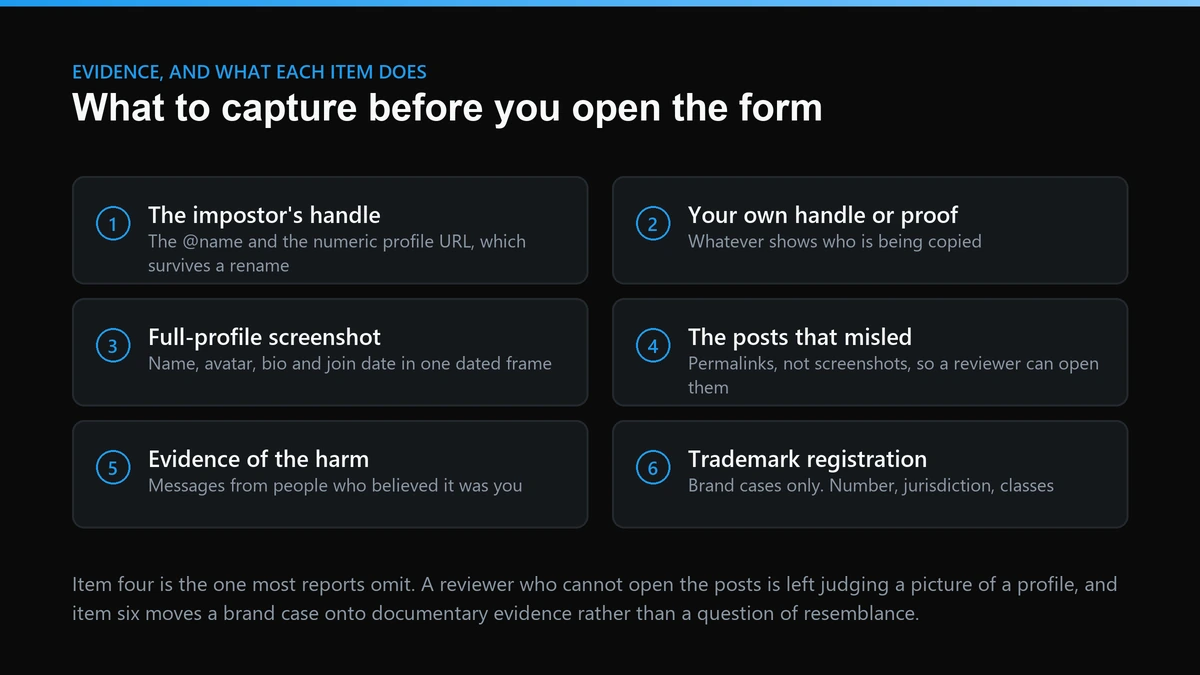
- Capture first. Save every profile and post URL with dated full-page screenshots before reporting anything, since a warned impostor may delete the evidence.
- Identity and copyright claims next. These forms ask for documents and only you or an authorized representative can sign them.
- In-app reports last. Harassment and scam reports go through each app's own menu.
- Log confirmations. Keep each reference for appeals and for the day a copy returns.
Fear of retaliation stalls many people at step three. Two pages cover it: whether a YouTube uploader learns who reported and what a reported TikTok user is told. If the same attacker also holds an X account, Twitter Ban Service can review that profile against the X Rules alongside the rest.
What does the platform decide, and what gets declined?
The platform decides whether a rule was broken, what the penalty is, and how much it tells the reporter.
A case moves through fixed stages. Intake collects the links, what happened and who is affected. The content is then read against the platform's published rule, and if it does not break one, the client is told so before any filing. Qualifying cases need authorization where the form requires the affected person, then go in through the official channel with evidence attached. The outcome belongs to the reviewer. X's impersonation help page says the affected person or an authorized representative can file, that no X account is needed, and that violating accounts are either suspended or asked to update the profile. An edit, in other words, is a legitimate result.
Twitter Ban Service declines requests against accounts that follow the rules: critics, competitors, ex-partners and clearly labeled parody. It declines volume tactics too, and the page on why mass reporting Facebook accounts, Pages and groups fails explains the mechanics. Report bots, copyright claims over work the client does not own, password or 2FA requests and guaranteed outcomes are all refused.
Sources
- X Help Center: Report impersonation accounts
- Instagram Help Center: impersonation reports and ID requirement
- Meta for Business: Brand Rights Protection new features, October 25, 2022
- FTC Business Blog: Take It Down Act enforcement, May 2026
FAQ
What is a content takedown service?
A content takedown service is a paid or in-house function that gets rule-breaking material removed by filing it with the platform that hosts it. The service does three jobs. It reads the post, profile or video against the platform's published rules, it picks the form that accepts that kind of violation, and it packages links, screenshots and identity or ownership documents so a reviewer can confirm the claim quickly. It does not hack, pressure or bribe anyone, and it has no access to moderation tools. On X the relevant rulebook is the X Rules; on Facebook and Instagram it is Meta's Community Standards; YouTube and TikTok each publish Community Guidelines. Twitter Ban Service works this way on X and applies the same routing when a case spills onto other networks. Every decision to remove content or suspend an account is made by the platform, and a correct filing can still be refused.
Is a monitor and takedown service worth paying for?
A monitor and takedown service earns its fee when fakes keep coming back, and is overkill for a single copycat. Monitoring means repeated searches for your name, logo, product photos or face, followed by a report on each confirmed match. A brand with a registered trademark should first apply for Meta's Brand Rights Protection, because brand impersonation monitoring on facebook and instagram is built into that tool: Meta's October 2022 update added an impersonation-only report option, an allowlist for your real Pages and automated recommendations drawn from reference images. Individuals and small sellers without a trademark can run a saved search weekly and use the public forms. Commercial vendors scan more networks and publish their own takedown rates, but those figures are self-reported, so ask what counts as a success and which platforms are covered before signing anything.
How do I file a Meta impersonation report?
A Meta impersonation report is filed from the fake profile's menu or, for the person copied on Instagram, through the Help Center form that works without an account. Open the profile, choose Report and pick the impersonation option. If you are the person copied, Instagram's Help Center asks for a photo of your government-issued ID and says it only responds to reports from the person being impersonated or their representative, such as a parent. That rule is why searches for report impersonation meta end in two different places: bystanders flag the profile, while the victim completes the identity form. A business with a registered trademark can also report through Brand Rights Protection. Keep the confirmation email. Meta alone decides whether the account is removed, and no outside party can speed that review.
What impersonation protection do Instagram and Facebook offer?
The impersonation protection instagram facebook users get comes in three layers: reporting forms, a paid subscription and a brand tool. The forms are free and open to anyone who is being copied. Meta Verified, the subscription Meta sells to creators and businesses, lists proactive impersonation monitoring among its benefits for subscribers. Brand Rights Protection, which sits in Meta's business tools, lets rights holders search Facebook and Instagram for Pages, accounts, posts and ads that use their brand, and report them for impersonation alone since Meta's October 25, 2022 update. None of these prevents a fake from being created. They shorten the time between creation and report. Practical steps help as well: claim your handle on both apps, keep the same profile photo across them, and tell followers which accounts are real so a copy looks wrong at first glance. A reporting service adds evidence handling, not special access.
Are deepfake impersonation fake account takedown monitoring services different from ordinary ones?
Only in detection; the filing routes are the same. Deepfake impersonation fake account takedown monitoring services add tools that look for a cloned face or voice in videos and ads, which a keyword search would miss. Once a match is found, the report still has to fit an existing rule: impersonation when a fake profile presents the synthetic person as real, fraud when a cloned executive or celebrity sells something, and intimate-imagery rules when the content is sexual. For that last category United States law now sets a clock. The FTC says it began enforcing the Take It Down Act on May 19, 2026, and covered platforms must remove reported intimate images, including AI-generated ones, within 48 hours of a valid request. Sexual content involving a minor goes to NCMEC's CyberTipline and the police first. No service should ask you to send that material to it.
Can I report Facebook, YouTube and TikTok accounts in one request?
No shared form exists, so each platform needs its own filing even when one person runs all the accounts. To report facebook youtube tiktok copies of the same attack, build one evidence folder and reuse it: profile URLs, dated full-page screenshots, your own official account links, and proof of identity or ownership. File the identity and copyright claims first, because those forms ask for documents and are the ones only you or an authorized representative can sign. Then use the in-app report for harassment or scams on each network. Facebook and Instagram share Meta's rules but keep separate report flows. Note each confirmation, since a later appeal or a re-registered fake is easier to handle with the earlier reference in hand. If the attacker also runs an X account, that profile is reported under the X Rules through X's own forms.
Can a takedown service guarantee removal or a suspension?
No. A takedown service that promises removal is selling something it does not control, since the platform's reviewers make every decision. What a careful service can promise is narrower: that the case was checked against the published rule before filing, that the right form was used, and that nothing false was submitted in your name. Twitter Ban Service declines requests aimed at accounts that follow the rules, including critics, competitors and clearly labeled parody. It also declines mass reporting, report bots and copyright claims over work the client does not own, because false notices carry legal risk for the person who signs them. Nobody at a legitimate service needs your password or a two-factor code. X states that accounts violating its misleading and deceptive identities policy are either suspended or asked to update the profile, which shows the range: a valid report can end in an edit instead of a suspension.