8 November 2026 · Twitter Ban Service · 10 min read
YouTube ban service: what can really be filed against a channel or a video
A YouTube ban service cannot ban a channel, because only YouTube's reviewers remove videos or terminate channels. What any helper can do is match the problem to the right official route: a policy flag, a copyright webform, a privacy complaint or a legal request. YouTube Help says three Community Guidelines strikes within 90 days can end a channel.
What is a YouTube ban service, in plain terms?
It is a paid offer to get a channel or video removed from YouTube, and the honest version can only prepare and file reports that YouTube then judges. Sellers use the phrase loosely. Some mean help writing one accurate copyright or privacy request. Others mean a crowd of accounts flagging the same upload, which YouTube treats as misuse of its reporting tools.
The difference matters because the platform says so in writing. YouTube's reporting help page states that reported content is not taken down automatically, and that if reviewers find no violation, more reports will not change the result. So a buyer is never paying for a ban. At best, the money buys clarity: which form fits, what evidence to attach, and whether the case is worth filing at all.
Twitter Ban Service is an X-focused reporting service, not a YouTube vendor, and this page explains the YouTube side only so you can judge any offer on its merits. Every rule cited here was read on YouTube Help in November 2026.
Channel removal or video removal: which outcome are you after?
They are two different results, and most complaints only justify the smaller one. A youtube video removal takes one upload offline after a single report, privacy complaint or copyright notice succeeds. A youtube channel removal, called termination, deletes the whole channel and, per Google's Transparency Report FAQ, every video on it.
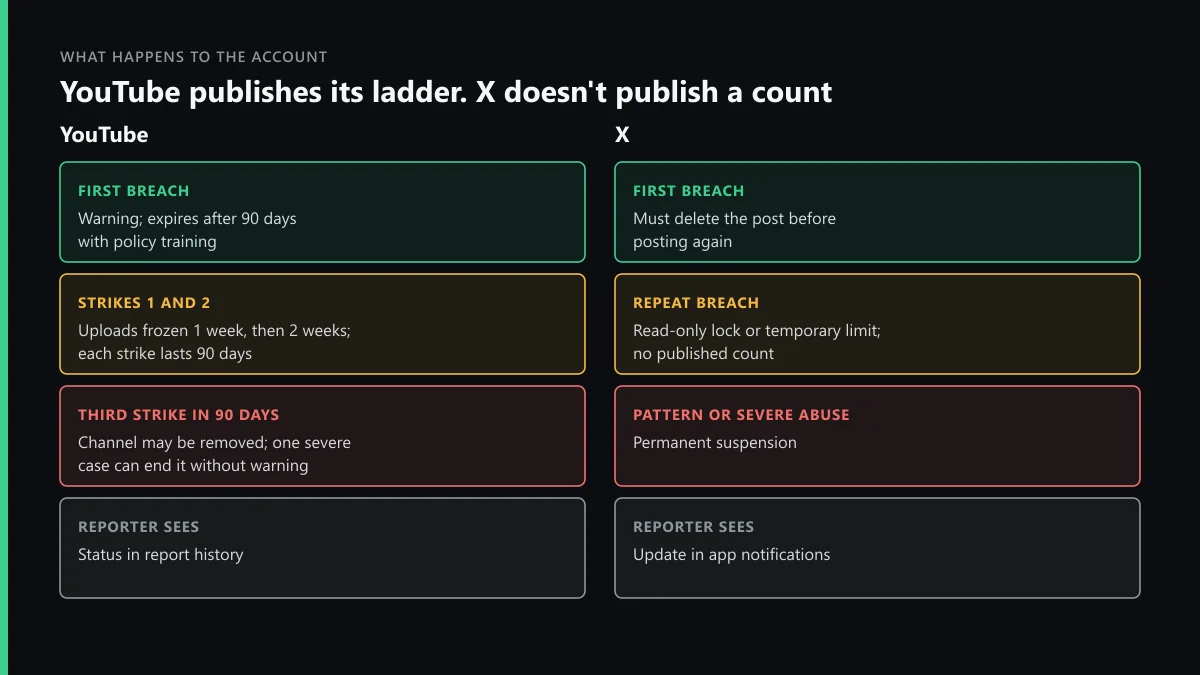
Termination has three documented triggers. The Community Guidelines strike basics page lists them: three strikes in the same 90-day window, a single case of severe abuse, or a channel dedicated to breaking policy, such as one built to impersonate someone. The first violation usually brings only a warning. A first strike freezes uploads for one week, a second within 90 days for two weeks.
That ladder explains why a youtube channel takedown rarely happens from one complaint. Each video is judged on its own, strikes accumulate per video, and the channel ends only when the pattern does.
Which official route fits each problem?
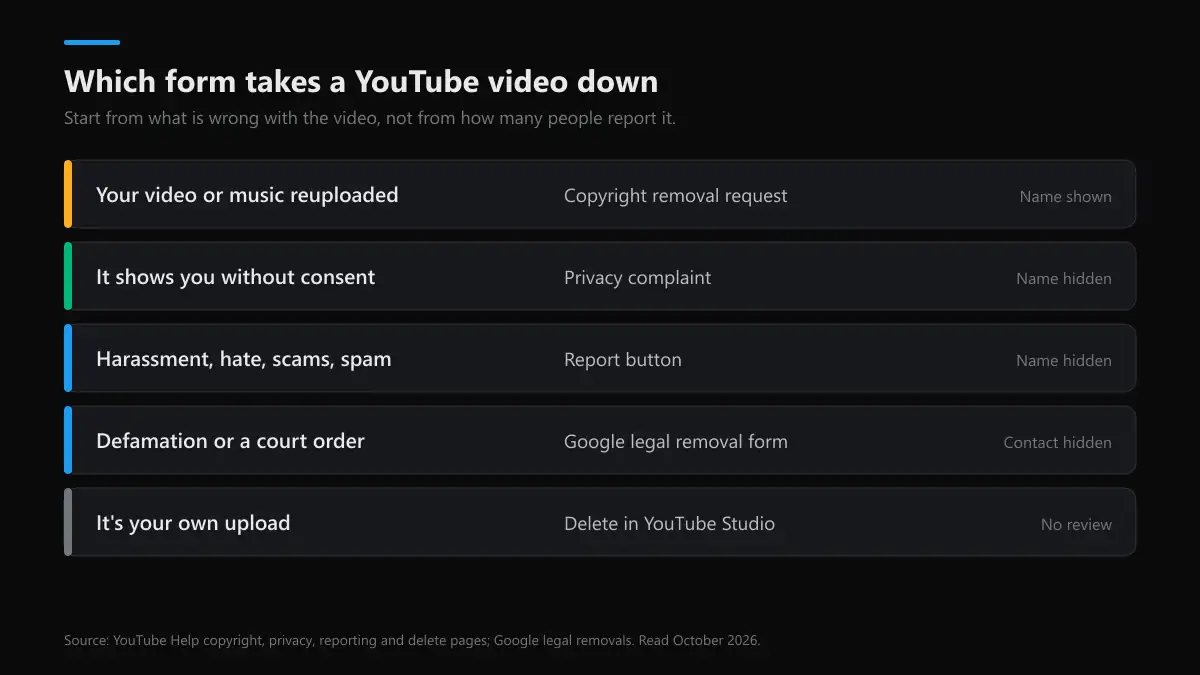
The route depends on what is wrong with the content, never on how many people dislike it. The table pairs common problems with the form YouTube built for each.
| Problem | Official route | Who may file |
|---|---|---|
| Harassment, scams, hate, spam | Report button on the video or channel | Any signed-in viewer |
| Your own video or music reuploaded | Copyright removal webform | The rightsholder or an authorized agent |
| Your face, name or contact details shown | Privacy complaint | The person shown, with narrow exceptions |
| A channel posing as you or your brand | Impersonation report | The person or brand impersonated |
| Defamation or a court order | Google legal removal request | The affected party or their lawyer |
Only the first row is open to everyone. The others belong to the person whose rights are hit, which is why a stranger offering to take down video youtube content you neither own nor appear in has no standing to file anything useful. Twitter Ban Service applies the same standing test to every X case it reviews.
How does a youtube video takedown for copyright actually work?
A copyright youtube video takedown is a legal notice under the DMCA, and only the copyright owner or someone authorized to act for them may send it. The webform asks for the exact video URL, a description of the original work, and a sworn statement that the claim is accurate. False notices can create legal liability for the sender, and YouTube shares the claimant's legal name with the uploader.
If the notice is valid, the video comes down and the channel receives a copyright strike. These sit in a separate system from policy strikes. Under YouTube's copyright strike rules, a strike expires after 90 days, and three active copyright strikes lead to termination of the channel and any linked channels. The uploader can ask the claimant to retract, wait out the strike, or send a counter notification, which can restore the video unless the claimant sues.
So a takedown video youtube request is strong but narrow: it protects a work you own. It cannot be borrowed to remove commentary you simply dislike. The same owner-only logic applies on other platforms, as this page on who can file an Instagram DMCA takedown shows.
What about privacy, impersonation and legal requests?
These routes are personal, and they often fit better than a policy flag. YouTube's privacy complaint process lets the person who is uniquely identifiable in a video ask for removal, and it can cover a whole channel without a single video URL. Reviewers weigh public interest and newsworthiness, so a clip of a public figure at a public event may stay.
Impersonation is a Community Guidelines issue. A channel copying your name, photo or brand can be terminated as a channel dedicated to that violation, which makes it one of the few paths where youtube channel removal can follow a single well-documented report.
Defamation, counterfeit goods and court orders go through the Google legal removals page, where Google reviews the request against local law. If the same impostor is active on X too, the steps differ there; see how impersonation cases run on Instagram and X.
What a legitimate service will decline
A service that works honestly turns down more requests than it takes. Twitter Ban Service, on its own X side, declines any account that follows the rules, however much the requester dislikes it, and the same test is the one to apply to any YouTube offer.
Walk away from a seller that asks for your Google password or a 2FA code, promises a ban by a date, quotes a number of reports needed, or claims an inside contact at YouTube. YouTube publishes no report threshold, and it bans misuse of flagging and automated access in its Terms of Service. A paid flag campaign can get the buyer's own account suspended while the target stays up.
Critics, competitors and creators you simply disagree with are not cases. Neither are rival channels with lower prices. If the content breaks no rule and infringes no right, blocking and muting are the realistic tools.
Where an X-focused team fits in a YouTube problem
Most abuse that starts on YouTube spills onto other platforms, and that is the part an X-focused team can work on. Harassers often post the same clip on X, scammers reuse a channel name as a handle, and impostors copy both profiles at once.
For X, the official steps are different. Reports go through X's own forms, and a stuck case can be escalated through X's customer service channels. A look-alike handle can be checked with a Twitter handle checker, and if the name you need is held by an impostor, this guide on a Twitter username that shows as unavailable explains the options. Some reporters also hit X's posting caps while documenting abuse; the page on rate limit exceeded on Twitter covers that.
For content spread across apps, see removing Instagram accounts, posts and reels and the overview of getting another person's Instagram or X account removed. On YouTube itself, you file, and YouTube decides.
FAQ
Is a YouTube ban service legal?
Offering help with a genuine report is legal, but selling bans is not something anyone can deliver. A YouTube ban service that drafts one accurate copyright, privacy or policy report for the person who has the right to file it is doing ordinary paperwork. One that organizes many accounts to flag a channel breaks the YouTube Terms of Service, which forbid misuse of reporting and automated access, and it can expose the buyer to account loss. A false copyright notice is worse, because the DMCA makes the sender liable for knowingly material misrepresentation. YouTube's reviewers decide every outcome, so no vendor can legally or practically promise one. Check what is being sold. If it is advice and filing support for your own case through official forms, it can be reasonable. If it is a ban, a deadline or a report count, the offer is the warning sign, and you should keep your password and payment.
How do I get a YouTube channel takedown started?
Start with one report under the rule the channel actually breaks, sent from the channel page while signed in. A youtube channel takedown is decided by YouTube, and a channel is terminated only after three Community Guidelines strikes within 90 days, a single case of severe abuse, or a finding that the channel exists to violate policy, such as impersonation. Before filing, collect the channel URL, the links to the worst videos, timestamps and screenshots, because uploads can vanish once the owner notices. If the channel shows you without consent, a privacy complaint can name the whole channel. If it reuploads your work, each video needs its own copyright notice. Expect no public update when a channel ends; the page simply becomes unavailable. Sending the same report again from other accounts adds nothing that a reviewer counts, so one complete file is the stronger approach.
What is the fastest youtube video takedown route?
The fastest route is the one that matches the problem exactly, because a correct form is reviewed against a clear standard. For your own reuploaded work, the copyright webform is usually the most direct youtube video takedown, since a valid notice from the rightsholder leads to removal without debating the video's tone. For footage showing you without consent, the privacy complaint process applies, and YouTube may first give the uploader 48 hours to edit or remove it. For scams, harassment and threats, the in-video Report button starts a policy review. YouTube publishes no general turnaround time for any of these, so anyone quoting one is guessing. Speed mostly comes from completeness: the exact URL, a timestamp, the right policy named, and proof of ownership or identity where the form asks for it. Incomplete requests are often sent back, which costs more time than any queue.
Can someone takedown video YouTube content they don't own?
Not through copyright. Only the owner of the work, or an agent they authorize, may send a copyright removal request, and YouTube warns that abusing the process can lead to suspension of the sender's account. Anyone who wants to takedown video youtube uploads they neither own nor appear in has one realistic option: the standard Report button, which asks reviewers to check the video against the Community Guidelines. That works when the video contains scams, hate, harassment, dangerous acts or spam. It does not work for criticism, parody or plain bad opinions, which are generally allowed. If you are shown in the video, you gain a second route, the privacy complaint, which is personal to you. A third party offering to file a copyright notice on your behalf for content you do not own is offering to make a false legal statement, and the liability sits with whoever signs it.
Does youtube video removal leave a strike on the channel?
It depends on which route removed the video. A removal after a Community Guidelines report usually brings a warning the first time and a strike after that, with each strike lasting 90 days. A copyright takedown places a copyright strike, tracked in a separate system that also ends the channel at three active strikes. A privacy complaint removal is handled differently, and YouTube has said it does not count as a Community Guidelines strike on its own, though repeated privacy violations can still lead to channel action. An age restriction or a removal the creator made themselves leaves no strike. For the reporter, this means youtube video removal and channel consequences are linked but not identical. You see the result in your report history, and the creator receives the email naming the policy, the timestamp if any, and the appeal option.
What is youtube channel removal versus a suspended channel?
Removal, which YouTube calls termination, is permanent: the channel and all its videos are deleted, and the owner is barred from creating or using another channel. A suspension in the everyday sense is the temporary upload freeze that follows a strike, one week after the first and two weeks after a second within 90 days, while the channel stays visible. Youtube channel removal happens after a third strike in that window, one case of severe abuse, or a finding that the channel exists to break policy. Creators can appeal both a strike and a termination, and some terminations are reversed on appeal. For someone reporting a channel, that means a quiet channel is not necessarily removed, and a returning channel under a new name may be ban evasion, which you can report under the policy its new uploads break.
Can Twitter Ban Service remove a YouTube channel?
No. Twitter Ban Service works on X and files nothing with YouTube, so it cannot report, flag or request the removal of any channel or video there. This page exists to help you read YouTube's own routes and to spot sellers promising what only YouTube's reviewers decide. Where the team can help is when the same person is also active on X: an impersonation account using your name, a scam handle reusing a channel's branding, or a harasser posting the same clip. In those cases, send the X profile link and your evidence. Each post is compared with the X Rules, and only genuine violations are filed through X's official channels, with X making the decision on any suspension. Accounts that follow the rules are declined. No password, 2FA code or login of any kind is ever requested, and no outcome or timeline is promised.